
As we navigate through the midpoint of 2026, the boundary between physical existence and digital memory is blurring at an unprecedented pace. While we have traditionally focused on the disposition of the physical body—ranging from classic burials to modern eco-friendly options like Aquamation—a new frontier has emerged that exists entirely in the cloud: the Digital Afterlife. Driven by rapid advancements in “Grief Tech,” AI-powered memorials are transforming from niche science fiction into a standard, albeit complex, part of the modern mourning process.
What is the Digital Afterlife? The 2026 Perspective
The term “Digital Afterlife” once referred simply to the collection of social media accounts, email data, and photo archives a person left behind. However, in 2026, the definition has expanded into something far more interactive. It now encompasses the “active” preservation of a person’s consciousness through Large Language Models (LLMs) and generative avatars. We are no longer just managing accounts; we are interacting with legacies in real-time.
This evolution in storytelling is a natural progression from the shifts we have already seen in the death care industry. For instance, as we’ve noted in our look at how AI is changing obituary writing, technology is allowing us to move away from static dates and toward dynamic, narrative-driven histories that capture the essence of a person’s spirit rather than just their resume.
The Mechanics of AI Memorials: How “Grief Tech” Works
AI Memorials function by synthesizing a vast array of personal data—voice recordings, social media posts, private journals, and video clips—to create a “Legacy Bot” or a high-fidelity digital avatar. In 2026, these tools are sophisticated enough to mimic a person’s unique syntax, humor, and even their specific vocal inflections. This process, often called “Data Scraping for the Soul,” involves feeding a localized AI model every scrap of digital footprint the deceased left behind.
For a family grieving the loss of a loved one, being able to “talk” to a digital version of that person can provide a unique form of therapeutic closure. When we examine the legacies of iconic figures, such as in our tribute to Catherine O’Hara, we see the power of a distinct personality. AI memorials attempt to bottle that personality, ensuring that the “inner voice” of a person isn’t lost to time. Just as we analyzed the distinct careers of veterans like Robert Duvall, AI allows for a curated, interactive retrospective of a life well-lived.
The Three Pillars of Digital Immortality
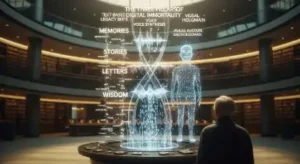
To understand the scope of the Digital Afterlife in 2026, we must look at the three primary ways technology is being used to preserve the deceased:
- Text-Based Legacy Bots: These are AI chatbots trained specifically on a person’s text messages, emails, and journals. They allow loved ones to send a message and receive a reply that sounds exactly like the person they lost.
- Voice Synthesis: Using “Deepfake” audio technology, families can preserve the voice of a loved one. This is often used to have the deceased “read” bedtime stories to grandchildren they never met or to narrate their own digital memoirs.
- Visual Avatars and Holograms: High-end memorial services in 2026 now offer holographic projections or VR environments where the deceased can be “present” in a digital room, allowing for a sense of physical proximity that traditional photos cannot match.
The Ethical and Legal Minefield of 2026
The rise of the digital afterlife has brought a host of legal challenges to the forefront. The question of “Digital Consent” is perhaps the most pressing. Does a person have the right to be “turned off” after they pass? Can a family create an AI version of a relative who never explicitly agreed to it? These are the complex legal puzzles of the modern age.
These scenarios often mirror the intricate details found in legal informational guides, such as our analysis of hit-and-run pedestrian accidents, where the absence of clear evidence or consent can lead to years of litigation. In the world of Grief Tech, the “evidence” is the data we leave behind, and the “litigation” is often over who has the right to control, monetize, or delete a digital soul. In 2026, we are seeing the first “Digital Kidnapping” cases, where hackers hold a loved one’s AI avatar for ransom, highlighting the dire need for cyber-security in the death care industry.
Psychological Impacts: Comfort vs. Prolonged Grief
Psychologists in 2026 are divided on the benefits of AI memorials. For some, these tools provide a bridge through the hardest stages of early grief, offering a way to say the “goodbyes” that were cut short by sudden tragedy. For others, however, there is a risk of “Perpetual Grief.” If a loved one is always available via a smartphone app, does the survivor ever truly move through the acceptance stage of mourning?
The “Uncanny Valley” effect—where an AI is almost, but not quite, human—can also lead to distress. Much like the eerie feeling of watching a film where a deceased actor has been digitally resurrected, an AI memorial that gets a personality trait “wrong” can be a jarring reminder of loss rather than a comfort. We saw similar discussions during the digital tributes to icons like James Van Der Beek, where fans debated the ethics of AI-generated content.
How to Prepare Your Digital Legacy: A 2026 Checklist
If you are interested in a digital-first approach to your afterlife, planning is essential. As we move further into a data-driven society, leaving your digital affairs to chance is as risky as dying without a physical will. Here is how to prepare:
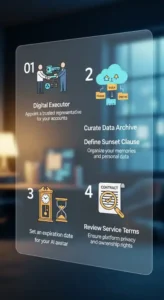
- Appoint a Digital Executor: This is a person specifically tasked with managing your social media, cloud storage, and AI assets. They should have the “keys” to your digital kingdom and clear instructions on what to preserve and what to delete.
- Curate Your Data Set: If you want an AI to represent you accurately, start curating your “Legacy Folder” now. Include your favorite stories, your core values, and audio recordings of your voice. This ensures the AI is trained on the “real you” rather than an algorithm’s guess.
- Include a “Sunset Clause”: Many people in 2026 are opting for a “digital expiration date.” This specifies that your AI avatar should be deactivated after a set number of years (e.g., when your children reach adulthood) to ensure you aren’t an eternal, unchanging ghost in their pockets.
- Check for Service Terms: Many “Grief Tech” platforms have varying terms of service. Ensure the platform you choose doesn’t own your likeness or have the right to sell your “personality data” to advertisers.
The Future: Toward Digital Immortality?
Where does this end? Some futurists believe that by 2030, we will have “Consciousness Uploading,” where the transition from life to digital afterlife is seamless. While we aren’t there yet, the AI memorials of 2026 are the first step toward a world where no one is truly forgotten. Whether this is a comfort or a burden remains to be seen.
At New Deaths, we remain committed to exploring the full spectrum of end-of-life topics. Whether we are honoring a legendary entertainer like Chuck Norris or discussing the latest in “Grief Tech,” our goal is to provide clarity in the face of the unknown. The Digital Afterlife is no longer a dream of the future—it is the reality of the present.
Conclusion
The rise of the Digital Afterlife and AI memorials doesn’t replace the need for traditional grieving; rather, it offers a new set of tools for a digital-first world. As we have seen with Aquamation and other industry shifts, humanity will always find new ways to honor those we love. By embracing technology with caution and empathy, we can ensure that our legacies are preserved with dignity for generations to come.