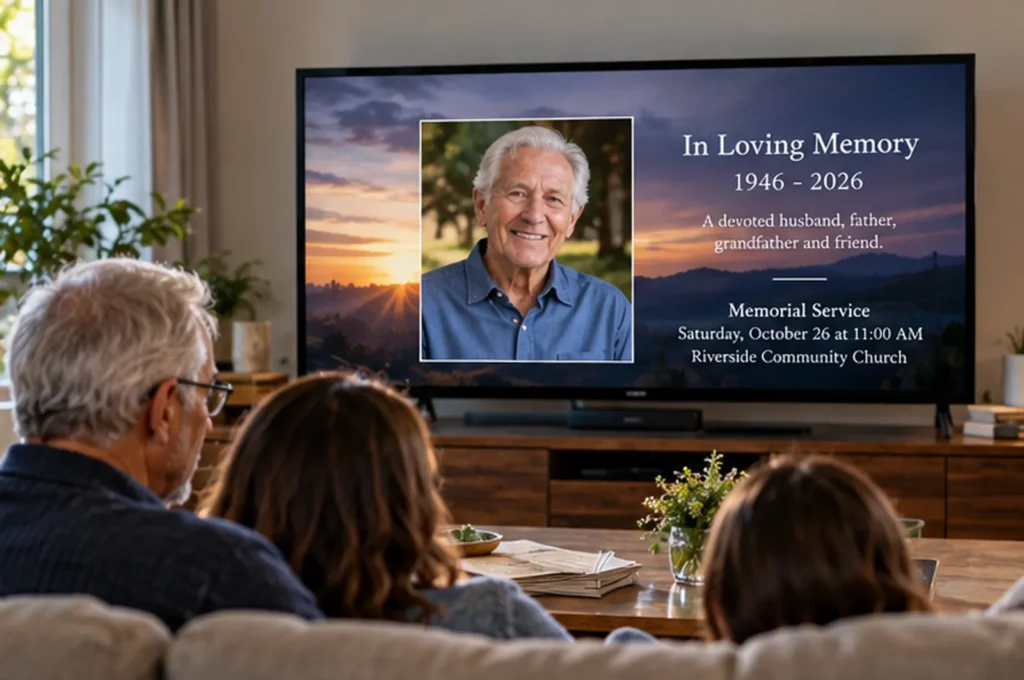
Funeral livestreams help relatives and friends attend memorial services when distance, health, work, or travel makes an in-person visit impossible. Unfortunately, that convenience has created a disturbing opportunity for online fraud. In 2026, fake funeral livestream scams remain a documented threat to grieving families and the people who want to support them.
The most common scheme begins with a genuine death announcement. Fraudsters copy the person’s name, photograph, and funeral details, then post a link that appears to offer a live broadcast. The link may lead to a fraudulent website requesting card information, payment, or login credentials.
Meta described a large-scale operation of this kind in its first-half 2026 adversarial threat report, reporting action against thousands of accounts involved in fake funeral livestream schemes. The National Funeral Directors Association has separately warned that funeral-related fraud attempts are becoming more sophisticated.
What Is a Fake Funeral Livestream Scam?
A fake livestream scam uses the promise of an online funeral broadcast to attract mourners to a fraudulent page or message. The memorial service itself may be real, but the advertised livestream could be invented, copied from another event, or hosted on a lookalike website.
One version is a fake social media page posing as the funeral home. Another is a comment posted beneath an authentic obituary: “Watch the service here.” Some scams reach mourners through private messages or unsolicited friend requests, increasing the chance that a link will appear to come from someone connected with the family.
Security researchers at Malwarebytes have documented fraudulent funeral livestream links and donation requests that exploit public memorial information. In some cases, clicking through leads to a page seeking payment details before allowing access to a video that does not exist.
Why Criminals Target Mourners
A memorial service has a fixed time. Someone who cannot attend in person may fear missing the only opportunity to watch. A scammer can exploit that urgency by suggesting a link will expire or that immediate registration is required.
Public obituaries also reveal details that make impersonation easier: the deceased’s name, service date, funeral home, family relationships, and sometimes a photograph. A fraudulent post containing several real facts can look unusually convincing.
This risk is especially relevant as obituaries move across more platforms. NewDeaths recently covered digital obituaries distributed through television, radio, local news, and mobile channels. Broader access benefits communities, but it also makes the verification of links more important.
What Meta Reported in 2026
In its first-half 2026 threat report, Meta described disrupting a network that targeted grieving users through fake funeral livestream pages. The company reported disabling approximately 8,600 accounts and 20 pages and taking action against thousands of associated operators.
According to the report, scammers impersonated funeral homes and bereavement organizations, used the names of recently deceased people, and tried to move mourners onto external websites that requested credit card information for supposed access fees or donations.
These figures describe enforcement activity against a particular network, not the number of families who paid money or the total scale of funeral-related fraud worldwide. The lesson is broader: apparently personal memorial messages can be coordinated attempts to steal information.
Warning Signs of a Fraudulent Livestream Link
A livestream should be verified before a viewer enters information or shares a link with other mourners. Watch for these warning signs:
- A stranger posts a link beneath an obituary or memorial announcement
- A recently created account claims to be the funeral home
- The webpage uses a strange or misspelled address
- A video requires unexpected card verification or an unrelated subscription
- The message demands immediate action because access will expire
- The page requests a social media password or security code
- Other mourners report conflicting links for the same service
None of these signs alone conclusively establishes fraud. Some legitimate providers may use paid or password-protected viewing arrangements. The critical difference is whether the link and any charges are confirmed through a trusted contact or the provider’s official website, rather than accepted from an unsolicited post.
How to Verify a Funeral Livestream
Start with the original funeral-home website or an announcement provided directly by the family. If an unfamiliar link appears in a comment, open a fresh browser tab and navigate to the funeral home’s known address yourself rather than using the comment’s link.
If necessary, call the funeral home using the number listed on its official website. Ask whether a livestream exists, which platform is hosting it, when it begins, and whether viewers must register or pay.
Families can also establish one official livestream destination and share it consistently through their chosen communications. That is particularly useful when arranging the kinds of personalized memorial services and hybrid gatherings increasingly offered today.
Beware of Fake Donation Requests
A related scheme uses the obituary to solicit donations. The message may claim to support funeral expenses, a memorial fundraiser, a grieving family, or a charity supposedly selected by the deceased.
Even when a real family is collecting contributions, viewers should verify the exact donation destination. The FBI’s charity fraud guidance advises researching organizations and treating unexpected requests for gift cards, wires, cryptocurrency, or cash with caution.
If a funeral home or relative shares a link to a fundraiser, confirm it through a separate trusted channel before donating. A social post can be copied; a known phone number and direct conversation provide stronger confirmation.
Impersonation Can Also Happen by Phone
Not every funeral-related scam uses a video link. A caller may pretend to work for the funeral home and demand immediate payment to avoid a service cancellation. Another may claim to be a cemetery representative with an unexpected account balance.
The FTC’s 2026 analysis of impersonation scams found that reported losses to this broad category reached $3.5 billion in 2025. That number is for impersonation scams generally, not funeral fraud specifically.
When payment is requested unexpectedly, hang up and contact the provider through a number independently verified on its official website or paperwork. Do not rely on caller ID alone.
What to Do if You Already Clicked
Simply opening a suspicious page does not always mean a device or account has been compromised. The appropriate next step depends on what occurred.
- If you entered a password: change it using the service’s real website and enable multifactor authentication
- If you entered card information: contact your bank or card issuer immediately and monitor transactions
- If you downloaded a file: update security software and scan the device
- If you sent money: contact the payment provider promptly about possible recovery options
- If you shared the link: alert the people who received it and identify the legitimate stream
Save screenshots of the message, account name, URL, and any receipts without forwarding the suspicious link unnecessarily. The FTC consumer scam resources provide additional guidance on common fraud tactics and recovery steps.

How to Report a Funeral Scam
Report fraudulent pages to the social media platform on which they appeared, and tell the funeral home so staff can warn other families.
In the United States, suspected consumer fraud can be reported through ReportFraud.ftc.gov. Internet-enabled fraud can also be reported to the FBI Internet Crime Complaint Center. These reports help authorities identify patterns, even if recovery of lost money is not assured.
NFDA’s May 2026 scam advisory likewise encourages funeral homes to document and report suspicious requests.
How Families Can Reduce Risk Before the Service
Before announcing a livestream, families and funeral professionals can take a few practical steps. Decide which account or website will host the official broadcast, confirm the URL, and post an explicit message that other links should not be trusted without verification.
A pinned comment or shared announcement can explain whether access is free, paid, or password-protected. Monitor public comment sections when possible and remove impersonation attempts quickly. Ask relatives not to repost an unfamiliar link simply because it includes the deceased’s photograph.
Families can also avoid publishing unnecessary private details. NewDeaths’ article about funeral price transparency explains the value of clear verified information; the same principle applies to legitimate broadcasts and payment instructions.
Conclusion
Fake funeral livestream scams exploit the urgency and trust that surround a memorial service. The threat is real, as 2026 enforcement and funeral-industry advisories demonstrate, but families can reduce the risk by verifying official links, treating unexpected payment requests cautiously, and reporting impersonation promptly.
Technology should make it easier to remember a person and support their loved ones. Taking a few moments to confirm where a livestream or donation link leads can help keep that experience safe.