
Planning a funeral in advance can spare relatives from having to guess about burial, cremation, ceremonies, and budgets. Paying for those arrangements in advance is a different decision. A prepaid plan can make costs feel settled, yet the fine print may determine what happens if prices rise, a family moves, the funeral home closes, or the purchaser changes their mind.
Prepaid funeral plans in 2026 deserve fresh attention because both consumer expectations and contract rules are evolving. Connecticut introduced new prepaid funeral contract requirements on July 1, while funeral professionals continue reporting interest in preneed planning and digital arrangements. A careful comparison can help families separate useful preparation from financial commitments they may not fully understand.
What Is a Prepaid Funeral Plan?
A prepaid funeral plan is an agreement to purchase specified funeral goods or services now for delivery after a future death. The contract may involve a funeral home, an insurance product, a trust, or another funding arrangement, depending on local law. Some contracts specify a complete service, while others cover only selected expenses.
Crucially, preplanning is not the same as prepaying. You can document preferences and compare providers without transferring money. The Federal Trade Commission’s funeral preplanning guidance encourages consumers to ask where advance payments go, whether they are refundable, and what happens if circumstances change.
Why Prepaid Plans Are a Timely Issue in 2026
More families now research arrangements online before speaking with a funeral director. The National Funeral Directors Association’s 2026 consumer research describes a market where online convenience is growing but personal professional guidance still matters.
Consumers should approach an online plan with the same care they would give any long-term contract. Easy sign-up is not a substitute for understanding cancellation, funding, fees, and transfer provisions.
What’s New in Connecticut’s 2026 Requirements?
Connecticut’s Department of Consumer Protection states that, beginning July 1, 2026, consumers must review the department’s funeral-services fact sheet before signing a qualifying funeral service contract. Its funeral service contracts page provides consumer information, contract rules, and a complaint route.
The department also published a July 2026 consumer alert explaining the new acknowledgment requirement.
The department’s updated contract requirements address matters such as cancellation terms, transfer provisions for certain irrevocable contracts, merchandise substitutions, and acknowledgments that required information was provided.
These requirements apply in Connecticut under its law; they do not automatically govern contracts sold in other states. Their broader lesson is useful everywhere: important terms need to be spelled out before money changes hands.
Where Does the Prepaid Money Go?
One of the most important questions is whether the money is held in a trust, used to purchase a funeral insurance policy, or managed in another permitted structure. The person selling the plan should explain who holds the funds, who the beneficiary is, and how the provider will receive payment after death.
The Michigan retirement education guide to prepaid contracts explains trust-funded and insurance-funded models. The rules governing deposits, investments, beneficiaries, and withdrawals vary by state and funding type.
The Michigan Attorney General’s prepaid funeral contract guidance recommends asking for proof of the funds’ placement and understanding who is responsible for the services. State rules vary, so seek the explanation that matches the contract’s governing jurisdiction.
Does Prepayment Lock in the Funeral Price?
Not necessarily. Some agreements guarantee specific covered prices; others promise a benefit amount but leave the family responsible for later shortfalls, additions, or third-party charges. An apparently comprehensive plan may exclude cemetery costs, flowers, transportation beyond a defined distance, certified records, or other items.
Ask the seller to mark every guaranteed item, identify every non-guaranteed charge, and explain what happens if an advertised item is discontinued. A clear contract should distinguish the actual goods and services being purchased from a general promise of future financial assistance.
NewDeaths’ guide to funeral price transparency explains how to compare itemized charges when evaluating arrangements. Apply the same approach to a prepaid contract. Federal consumer protections under the FTC Funeral Rule also apply when making funeral arrangements in advance.
Revocable and Irrevocable Plans Are Different
A revocable agreement generally allows some form of cancellation or change, subject to its terms. An irrevocable agreement limits the right to revoke or receive the money back, sometimes for eligibility or planning purposes. Neither label alone tells you everything you need to know.
An irrevocable plan is sometimes considered during Medicaid eligibility planning, but treatment depends on state rules and the exact arrangement. Never assume a product is Medicaid-exempt simply because a salesperson calls it irrevocable; ask a qualified benefits or legal adviser to review the consequences.
Ask for the cancellation process in writing. Does the purchaser receive a refund of the original payment, a current cash value, or a reduced amount after fees? Who can authorize a change? Does the right to transfer survive a funeral home’s ownership change?
The Funeral Consumers Alliance’s preplanning guidance emphasizes that planning without prepaying may give families more flexibility. That position is a useful counterweight to promotional claims that advance payment is always the safest choice.
What Happens If You Move or Die Away From Home?
A contract tied to a particular provider may be less convenient if a person moves to another state or dies while traveling. Some plans permit transfers, but the receiving funeral home may not honor the original prices. Transportation and out-of-area fees can add further costs.
Ask what a transfer would cost, whether a new provider must agree to accept the funds, and who would help the family arrange services when the time comes. If a contract uses insurance, ask whether the policy beneficiary or assignment can be changed.
What If the Funeral Home Goes Out of Business?
Closure or ownership change is a real long-term risk. Review how the arrangement is protected if the seller ceases operating. Ask who keeps records, which regulator oversees the plan, and how the family can identify the trustee or insurer independently.
The FTC urges consumers to ask specifically whether their payments are protected if a funeral provider goes out of business. A well-written answer should explain the funding arrangement, not merely reassure the buyer that the company has been around for years.

How to Compare a Prepaid Plan With Other Options
Prepaying is one strategy, but not the only one. Families can document wishes, keep a dedicated savings account, use an appropriately structured payable-on-death account, or consider other financial arrangements. Each has its own legal, tax, insurance, and beneficiary considerations.
The Funeral Consumers Alliance’s payment guide discusses prepayment, savings, insurance, and other approaches. Before choosing, compare liquidity, fees, risks, and how quickly relatives can access funds.
Families can also explore less costly or different services without making a financial commitment. NewDeaths covers changing burial and cremation preferences and personalized celebrations of life, both of which can help define what a future arrangement actually needs to include.
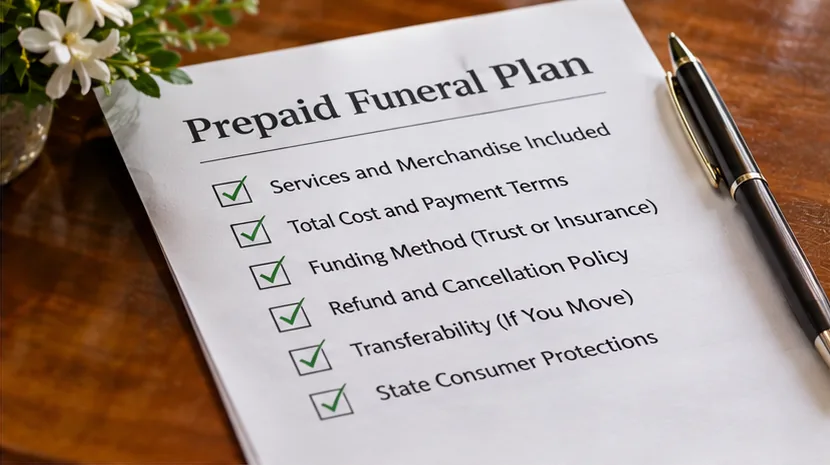
Seven Questions to Ask Before Signing
- Exactly which goods and services are covered, and which are excluded?
- Is the price guaranteed, or is only a benefit amount guaranteed?
- Where is the money held, and can that be independently verified?
- What happens if I cancel, move, or change providers?
- Can the contract be transferred, and will any price promise transfer too?
- What happens if the funeral home or insurer closes?
- Who should my family contact, and where will the records be kept?
Always obtain a complete copy of the signed agreement, disclosures, funding confirmation, and contact information. Share their location with a trusted person. A contract that no one can find may fail to accomplish the very purpose for which it was purchased. For unfamiliar terms, consult the NewDeaths plain-language funeral terminology guide.
Conclusion
Prepaid funeral plans in 2026 sit at the intersection of family planning, consumer protection, and long-term financial commitments. Connecticut’s newer contract rules and the FTC’s longstanding guidance underscore the importance of knowing exactly what was purchased and how the money will be handled.
Planning ahead can be valuable even when no money is prepaid. If advance payment makes sense for a particular situation, choose a plan only after verifying its funding, cancellation rights, coverage, transfer rules, and protections if a provider closes. The goal is not merely to sign a contract today; it is to leave clear, usable arrangements for the people who will depend on them later.